Comprehending Peptide Pureness: What 99%+ Really Means
Comprehending Peptide Pureness: What 99%+ Truly Implies
HPLC actions chromatographic pureness by separating the target peptide from related impurities and computing main-peak area percent. Mass spectrometry validates molecular identity by examining whether the measured mass matches the anticipated peptide mass. For research-grade peptide certification, HPLC and LC-MS/ESI-MS answer various concerns and must be read with each other. BOC Sciences additionally supplies detailed in vitro (cell platforms) and in vivo (animal platforms) testing solutions to assist clients totally recognize peptide formulation efficiency in various environments. Artificial insemination tests evaluate peptide cytotoxicity, cell uptake, anti-inflammatory task, and a lot more, supplying fundamental data sustain for peptide applications in clinical appearances and biomedical areas.To conclude, recognizing peptide pureness degrees and qualities aids you make notified decisions for your experiments. A peptide's pureness percentage tells you just how much of that sample is the real bargain versus byproducts, with usual research study grades being around 95% approximately 98-99% for extra pureness. Analytical HPLC and MS are your close friends here-- HPLC quantifies pureness, and MS verifies identity, together ensuring you know what remains in your tube.
The Certain Approach: Reversed-phase Hplc
- For experimental preparation (like determining molar concentrations), both purity and net web content are useful numbers, but purity is what reflects the chemical homogeneity of the peptide sample.
- The injector presents a precise volume of example into the mobile-phase stream.
- Nevertheless, for total top quality analysis or the characterization of peptides for a range of applications, added analytical tests are advised.
- With each other, these tools supply a clear and in-depth image of peptide composition, guaranteeing researchers can trust their data.
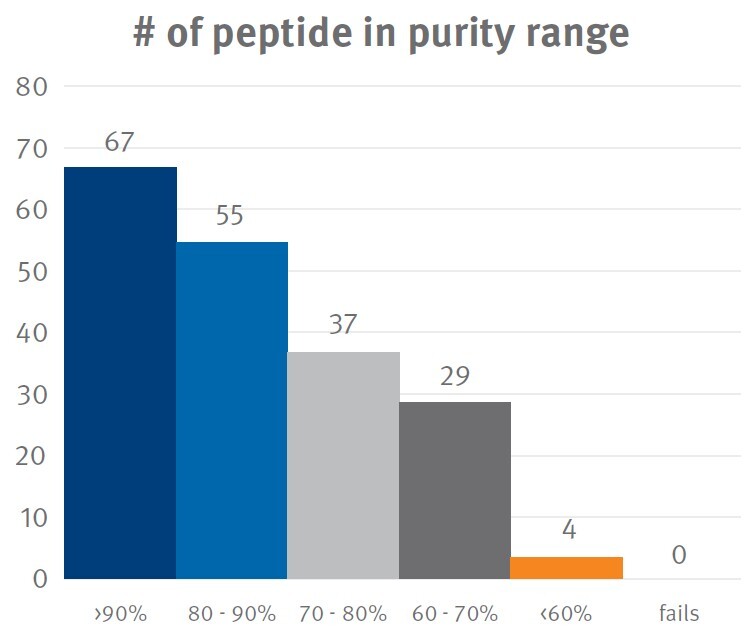
The software application draws limits around each top and computes the location underneath. The purity percent originates from comparing the location of the major height to the total area of all discovered tops. A lot of reports consist of a table listing each top's retention time, area, and percent of overall location.
Can Hplc Identify Peptide Degradation?
We sustain amino acid structure evaluation and web peptide content analysis for teams that require more trustworthy focus setting and set interpretation. HPLC-tested means the example was run through high-performance fluid chromatography to separate the target peptide from pollutants. The pureness percent is normally calculated from the main peak location divided by the overall incorporated top area.

Start Your Peptide Evaluation Task
Also, bear in mind that "research-grade" peptides are suggested for the lab bench and feature high pureness and identification checks but are not generated as medications. Always check that your peptide includes correct logical information (HPLC chromatogram and MS outcomes) and is classified for research study usage. Armed with this knowledge, you can confidently translate tags like "95% pureness, study quality" and utilize those peptides to drive your experiments without complication. Knowledge of purity degrees will also direct you if you ever require a higher pureness peptide for an especially delicate assay. Ultimately, obtaining the purity level right indicates extra trustworthy scientific research-- which's the best objective for any type of scientist. With years of logical screening experience and progressed instrument platforms, BOC Sciences gives thorough peptide high quality testing services across the entire process from basic materials to formulas.
HPLC informs you what percentage of your sample is the major substance-- but it does not confirm what that main substance really is. A height with the appropriate retention time can in theory be a relevant peptide with similar hydrophobicity. Mass spectrometry gives identification verification by determining molecular mass directly. We evaluate peptide size, sequence composition, anticipated molecular weight, modification kind, salt form, example background, and designated downstream usage before specifying the logical path. These are important in the right setup, however they need to be taken method-specific evidence as opposed to an universal replacement for HPLC and MS. Yet peptide pureness is arguably the single crucial quality statistics for any type of study peptide. It directly affects the integrity and reproducibility of speculative results. A peptide provided at 75% pureness and one at 99% purity aren't simply different grades-- they can create meaningfully various outcomes in the very same assay.